Treasures of Tudor England
Notes From the Stacks
by Lili Dowell, Special Collections Assistant

A look at documents signed by Queen Elizabeth I and King Henry VIIIby Lili Dowell, Special Collections Assistant
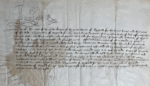
If you visited Pequot Library this summer, you may have noticed a pair of special artifacts from Tudor England displayed in our exhibition: two documents bearing the signatures of legendary rulers, Queen Elizabeth I as well as her father King Henry VIII. Though they are on a long term loan at Yale’s Beinecke Library, they temporarily returned to the to be a part of Treasured Tomes: Rare Books and Their Collectors, on view from June 12 through September 20, 2025.
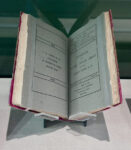
The documents came to Pequot Library from the collection of Charles Deane (1813-1889). Deane was a historian based in Cambridge Massachusetts, and his library of rare documents and Americana was considered one of the most valuable of its kind at the time. When his library was sold at auction in 1898, the New York Times was there, documenting the excitement in the room as Rev. William Holman raised his paddle. He bought at least 15 other items from the sale on behalf of Catherine Wakeman, who gifted the items to Pequot Library along with a new stacks wing. The original catalog of Charles Deane’s library auction (below) is also on view as part of the exhibition.
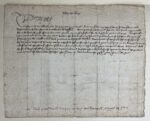
This 1533 signet letter orders the recipient, William Brereton, who is chamberlain of Cheshire, to make out letters patent under the seal of the County Palatine of Chester for William Davenport to become the sheriff of Chester. This move would give Davenport judicial, military, and administrative authority over the county of Cheshire, which was quite a powerful position.
At the time this letter was written, William Brereton was a highly trusted figure in the court of Henry VIII. Yet the favor he enjoyed at court would not last. Three years later, Brereton would be accused of adultery and executed alongside Henry VIII’s wife Anne Boleyn and four others. The charges, however, were fabricated. Historians now recognize that the entire group was executed unjustly. Brereton’s own inclusion in the execution group stems from his opposition to the crown’s interest in severing the nation from the Catholic Church.
Tracy Borman’s book Anne Boelyn & Elizabeth I has a more harsh perspective on Brereton’s rule: “…In his native Cheshire, where he was a steward of the Marcher Lordships, his behavior was so ruthless that it sparked widespread resentment. He dominated local monasteries to his advantage and even ordered the judicial murder of his former deputy. His unscrupulous activities soon came to the attention of Thomas Cromwell, who subsequently involved him with Anne’s downfall. Of all the men accused of adultery with her, Brereton was the least likely to have been guilty. Not only was he considerably older than the queen, but he was not part of her inner circle”.
The reason the letter is addressed to Brereton himself has to do with the structure of the Tudor government. In the absence of modern bureaucracy, official legal decrees were addressed to the individual people in power, rather than a specific office or branch.
Brereton’s removal allowed the crown to regain greater control over the area, and ended the monopoly of the authority by a single person. In his place, the crown appointed a handful of different authorities to control Chester, one of which included Urian Brereton, William’s brother.
Beyond its political significance, the document also holds material interest. A detail that might be easy to miss on first glance is this hand shaped watermark in the center of the paper (see the image below). Watermarks served as a manufacturer’s logo, as well as giving an indication for the kind of paper and the quality.
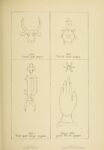
Watermarks came in all shapes and sizes. This particular hand (or glove) symbol was common during Henry VIII’s time, often accompanied by a crown, a star, or a fleur-de-lis. To create the form, a wire would have been bent to create the desired shape, and then placed inside a paper making tray. When the wet paper pulp dried, it would leave a shadow of the shape imprinted on the center of the paper.
If Henry VIII’s warrant highlights the turbulence of his reign, Elizabeth’s document offers a different perspective on Tudor government. The second item is Queen Elizabeth I’s document with a sign manual “Elizabeth R”. It appears to be an administrative document on parchment, declaring that the identity of the offices of Lord Keeper of the Great Seal and the Lord Chancellorship of England function as one. Elizabeth’s flourishing signature heads the top of the page, and her first name is followed by an “R”, which stands for Regina (or queen in Latin). Sir Nicolas Bacon had the role of Keeper of the Great seal shortly after Elizabeth became queen, and would have been the person most affected by this decree.
To appreciate the weight of her signature, it helps to look back upon Elizabeth’s rule. Queen Elizabeth’s reign over England is sometimes described as a “Golden Age”. She became Queen of England at the age of 25, and during her 45 year long reign (the longest of any Tudor monarch), she revolutionized the nation and broke the mold for British women of the time. She chose to never marry, stating “I am already bound unto a husband, which is the kingdom of England”.
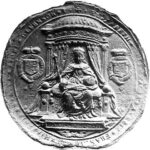
First Great Seal of Queen Elizabeth I, 1559-1587. Image from Mernick.org.uk.
A significant representation of her authority was the Great Seal of England. It carried a huge amount of weight, as it gave validity to her signature and embodied her political legitimacy. Although framed in masculine language, the following excerpt from the Canadian Bar Review applies equally to the queen as to the king: “The king’s signature to a document may be authenticated in two ways: either by the affixing of the Signet or by the affixing of the Great Seal. The appearance of one of these seals is essential to the validity of the King’s signature. Without the seal the signature is incomplete” (Stewart).
Elizabeth I took a keen interest in her Great Seal, preferring to physically deliver it into the custody of her courtiers with her own hands. She also is said to have taken a significant role in their design, repeatedly reviewing patterns and models of new designs throughout her reign.
Second Great Seal of Queen Elizabeth I, 1586-1603. Image from Mernick.org.uk.
“The Great Seal was also an important instrument of propaganda. Of all the Tudor monarchs, Elizabeth I was the most skilled at crafting her public image. This, her second Great Seal, is laden with symbolism. The inscription reads: Elizabetha dei gracia Anglie Francie et Hibernie Regina Fidei Defensor (‘Elizabeth, by grace of God, Queen of England, France and Ireland, Defender of the Faith’). It depicts the queen in resplendent dress, flanked by the royal arms and Tudor roses. It was engraved by the celebrated miniaturist Nicholas Hilliard” (The National Archives).
To get more clarity on our documents, I reached out to Dr. Heather Wolfe, a curator and archivist at the Folger Shakespeare Library in Washington D.C. She specializes in English manuscripts, and has extensive experience deciphering handwriting and contextualizing documents from this time period.
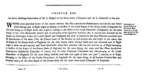
One unresolved question in my research concerns the dating of Queen Elizabeth’s letter. Unlike Henry VIII’s item, there is no date on the document itself. Both Pequot Library’s files and Yale’s records have estimated it to the year of 1559, which was only one year after Elizabeth’s reign began. What seems inconsistent with this date is that the law this letter concerns, The Lord Keeper Act, was officially passed in 1562, around three years later.

Wolfe was able to provide a link to the act as it was passed (see image below). When comparing the two, Wolfe said “The wording is slightly different in parts from your [manuscript], so maybe they rejected the version that you have. It does make me wonder if Elizabeth signed blank pieces of parchment that her Council then filled out.”
Another reason the document stuck out to her is because it is incomplete. “There is no date or seal, just an endorsement noting the contents. I think you are right to date it more closely to the act that merged the two positions”.
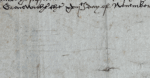
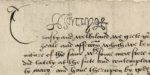
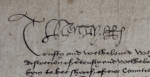
Wolfe was also able to provide insights into the kings signature. Henry VIII notoriously disliked paperwork. Throughout his rule, he used secretaries to craft his documents, particularly ones that would have been considered to be menial administrative tasks. Near the end of his reign, this even extended to his signature. He began using something called a ‘dry stamp’ to sign his documents rather than taking the time to personally recreate his signature each time. The dry stamp would have been made of metal, and imprinted a facsimile of the king’s signature. Initially I was unsure how the signature on our own document was created, and Wolfe was able to provide an example of dry stamp vs. a pen signature. While the body of Pequot Library’s document was certainly written by a secretary, the sign manual looks like it was written by hand, rather than a dry stamp.
To get a better idea of the comparisons, see the two images below, where the ink on the left is significantly more uniform than the looser, darker signature on the right.
These two items embody just how unique Pequot Library’s collections are. Through looking at King Henry VIII’s and Elizabeth I’s documents, we are able to see the ways they projected their authority and shaped history in ways that are still felt today.
A list of references used:
- Borman, Tracy. Anne Boleyn & Elizabeth I: The Mother and Daughter Who Forever Changed British History. Grove Atlantic, 2023.
- Hall, Jill M. “Elizabeth’s Symbolic Marriage to England: A History of Lasting Union.” Early Modern Studies Journal, 6 May 2022.
- Borman, Tracy. Henry VIII: And the Men Who Made Him. Grove Press, 2019.
- “The Great Seal of Elizabeth I.” The National Archives.
- Kropf, Evyn. “Watermark Wednesdays: Hand / Glove.” University of Michigan Library , 24 Sept. 2014.
- Scott, Henry T., and Samuel Davey. A Guide to the Collector of Historical Documents, Literary Manuscripts, and Autograph Letters, Etc… S.J. Davey, 1891.
- Skidmore, Chris. The Rise of the Tudors the Family That Changed English History. St. Martin’s Press, 2013.
- Stewart, Robert B. “The Great Seal and the Treaty-Making in the British Commonwealth.” Canadian Bar Review, Vol. 15, No. 10, Dec. 1937.
- Weir, Alison. The Lady in the Tower: The Fall of Anne Boleyn. W F Howes, 2018.
- Wolfe, Heather. “Two Versions of Thomas Cromwell’s Very Urgent Letter Conveying Henry VIII’s Impatience over His Impending Marriage to Anne of Cleves.” Folger Shakespeare Library, 30 May 2024.
- The Statutes of the Realm: Printed by command of his majesty King George the Third. In Pursuance of an Address of the House of Commons of Great Britain. From Original Records and Authentic Manuscripts. Volume the Fourth. London, 1963.